
Every year, Alberta magazines give emerging writers opportunities to develop their craft through paid internships, mentorship, and publication. Working alongside experienced editors and magazine teams, new writers build their skills, strengthen their storytelling and gain valuable experience in the industry. The Alberta Magazine Awards further recognize new talent through the Emerging Writer category. Together, these opportunities help cultivate new voices and fresh perspectives while contributing to the future of Alberta’s magazine sector.
Meet the 2026 Emerging Writer finalists and read their award winning stories.
Gold winner, EMILY JOHNSON
 Ask Emily Johnson how she finds a good story, and her answer is simple: talk to people about what they love. It’s an approach that has helped her discover a rich source of stories in Alberta’s agricultural community.
Johnson’s interest in agriculture began after she graduated from First Nations University with a degree in marketing and a minor in Indigenous Studies. While working for Alberta’s crop commissions, organizations that represent and support the province’s farmers, she became fascinated by the agricultural community and the relationship farmers have with the land. That fascination eventually led her to writing for GrainsWest, a magazine published by Alberta Grains.
I didn’t know how much I loved that industry and that community until I started working for them. A lot of people just think about the end product, but the farmers all have incredible stories. There are so many people working so hard; we just don’t really think about that.
“I think there’s something really cool when someone spent 10, 20, 30, 40 years trying to make those discoveries and research those important topics. It’s really cool to be able to tell those stories, find out what their passion is and then relay that to people who might not be able to ask researchers questions in the same way that I’m able to,” said Johnson.
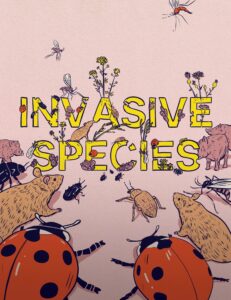
When Ian Doig, her editor at GrainsWest, commissioned her to write about invasive species in Alberta, Johnson saw an opportunity to give farmers practical information they could use to help prevent invasive species from taking hold and spreading on their land.
The judges praised the gold-winning Emerging Writer entry for making a complex subject accessible: “This well-reported, well-researched feature is full of helpful information that will be useful to both the magazine’s core constituency of agriculturally-minded readers and a general interest audience. The author has done a wonderful job of making specialized knowledge accessible and interesting to a wide-ranging readership.”
That usefulness was important to Johnson.
“A lot of farmers are kind of paying the price now that those species are kind of creeping in, but it’s great if everyone can kind of just be alert and take a little extra time to see what’s going on in their field so that they can have a better chance of fighting back,” said Johnson.
Silver winner, MEGHAN LETT
 For Meghan Lett, the best way to find good stories is by talking to people and paying attention to what they have to say.
“I find that people are very often up to interesting things that I would have never found out about if I hadn’t asked the questions, you know?”
Lett knew from a young age that she wanted to become a writer. Her home was filled with books, more like a library than a house, and she was determined to read as many as she could. Her love of literature soon sparked a dream to write stories of her own and make a living doing it.
She was also inspired by her father, a journalist and television anchor. Lett grew up watching him on the news and reading his articles, and it wasn’t long before Lett was realized she wanted to follow a similar path.
During her time as an intern at The Sprawl, founder and editor Jeremy Klaszus offered the opportunity write about Calgary’s urban forest. What he didn’t know was that she had already developed a special interest in trees while working a landscape job. That interest later led her to write about SAIT’s trees during her time as a student, making The Sprawl assignment a natural fit and an opportunity to explore a subject she already cared about.
“He said, ‘I know that probably doesn’t sound very interesting’. It was funny. I had that same experience when I pitched my tree story to my teachers. I’m not sure they trusted that it was going to be very interesting.”
The Alberta Magazine Awards judges thought otherwise, praising the story as “an insightful and educational look at the life and function of trees in the urban landscape, told in a surprising and engaging way.”
Finalist, LIAM NEWBIGGING
 Being a writer never really crossed Liam Newbigging’s mind. It was only at MacEwan University, where he majored in Music, that Newbigging realized he was more interested in putting words on paper than in compositions and music theory. It took time to let go of the idea that the career he had chosen was no longer the one he wanted. Eventually, he transferred programs and pursued a career in journalism.
The decision paid off. He career began with an internship at Edify and he has continued to freelance for the magazine since. This year, an article he wrote for Edify was shortlisted in the 2026 Alberta Magazine Awards’ Emerging Writer category.
The story did not begin with that recognition in mind. Initially, Newbigging planned to write about Edmonton’s growing apartment lifestyle. But the idea began to shift when then editor-in-chief Omar Mouallem encouraged him to look for stories that explored broader social and economic trends shaping the city.
Around the same time, Newbigging was researching housing statistics for a school assignment when he came across data showing a striking trend: for the first time, more homes were being built for rental than for ownership. Intrigued, he began digging deeper into the numbers and quickly realized there was a much larger story beneath the surface. What started as a lifestyle piece evolved into an examination of changing housing patterns in Edmonton and what they mean for residents, developers, and the future of the city.
“As soon as I started looking at the data, I knew there was something there,” Newbigging recalls. “The numbers pointed to a significant shift, and I wanted to understand what was driving it.”
“It was a pretty lengthy and effort-intensive process, but then once you get through that process, you know, with the help of a good editor like Omar, you end up with that moment of clarity where everything clicks.”
Finalist, SAM SASSE
Sasse, a media relations specialist at Lethbridge Polytechnic, has learned to recognize one important sign of a good story: when someone talks about a subject with genuine passion, there’s usually a story worth telling.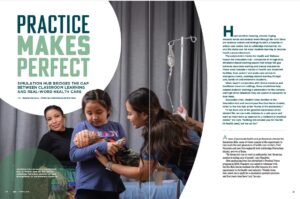
“I think what really sells it to me is when I’m talking to the person about it, and they’re excited to talk about it. If they’re passionate about it, there’s something there that I can latch onto, and if I can latch onto it as a writer, I’m sure someone’s willing to read it.”
That instinct helped shape Practice Makes Perfect, which was shortlisted in the Emerging Writer Category. The story began when Lethbridge Polytechnic’s simulation hub received accreditation from the Society for Simulation in Healthcare, making it one of four post-secondary institutions in Canada to receive the distinction.
The communications team initially planned to announce the accreditation through a press release. But they soon realized there was a larger story to tell and decided to explore it in Wide Horizons, the Polytechnic’s community magazine.
“It was a way of taking their passion and channeling it into written format to pass that on to the audience.”
Sasse was accustomed to translating technical research, from agriculture and technology to public safety, for a general audience. But Practice Makes Perfect presented a new challenge: finding a way to make a complex subject both engaging and accessible.
The judges said he succeeded, calling the piece “a fascinating window into an important space of learning and technology.” They praised the way its “dynamic scenes bring the fast-paced, immersive nature of the simulation program to life.”
Finalist, VIANCY SALUBRE
 For Viancy Salubre, good stories begin with curiosity, paying attention to small details, talking to people you might otherwise overlook and continuing to ask why and how.
“I think that a huge part of it is just being able to talk to so many people that I wouldn’t originally think have something interesting to say.
“A story can be told so many different times, and just trying to ask a different question about it or being curious about it in a different way is one of the best ways you can try to tell a story,” said the journalist.
Salubre’s interest in writing began in high school, where creative writing classes eventually led to becoming an editor at the school’s newspaper. Journalism brought together many of the creative interests Salubre enjoyed, prompting her to pursue a journalism diploma at SAIT.
There, she found herself drawn to stories about Calgary’s arts scene.
“As someone who had grown up in Calgary, I think the arts was always something that I was very interested in.”
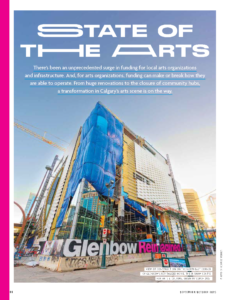
She became curious about the impact large-scale arts funding investments had on Calgary’s broader arts communities. That became the starting point for State of the Arts, a story Salubre pitched while interning at Avenue, where she now works as an events and listings editor.
“I was grateful for the opportunity to have covered something like this. To not just see all of the research and work that I’d put in to be a tangible thing, but also for it to reach such a place that, you know, people were reading it, and being informed (by it).”
The experience also marked an important step in Salubre’s development as a journalist.
“I don’t think that I would have grown as much as a writer if I hadn’t taken on this piece,” said Salubre.